Kiyomizu-dera in brief
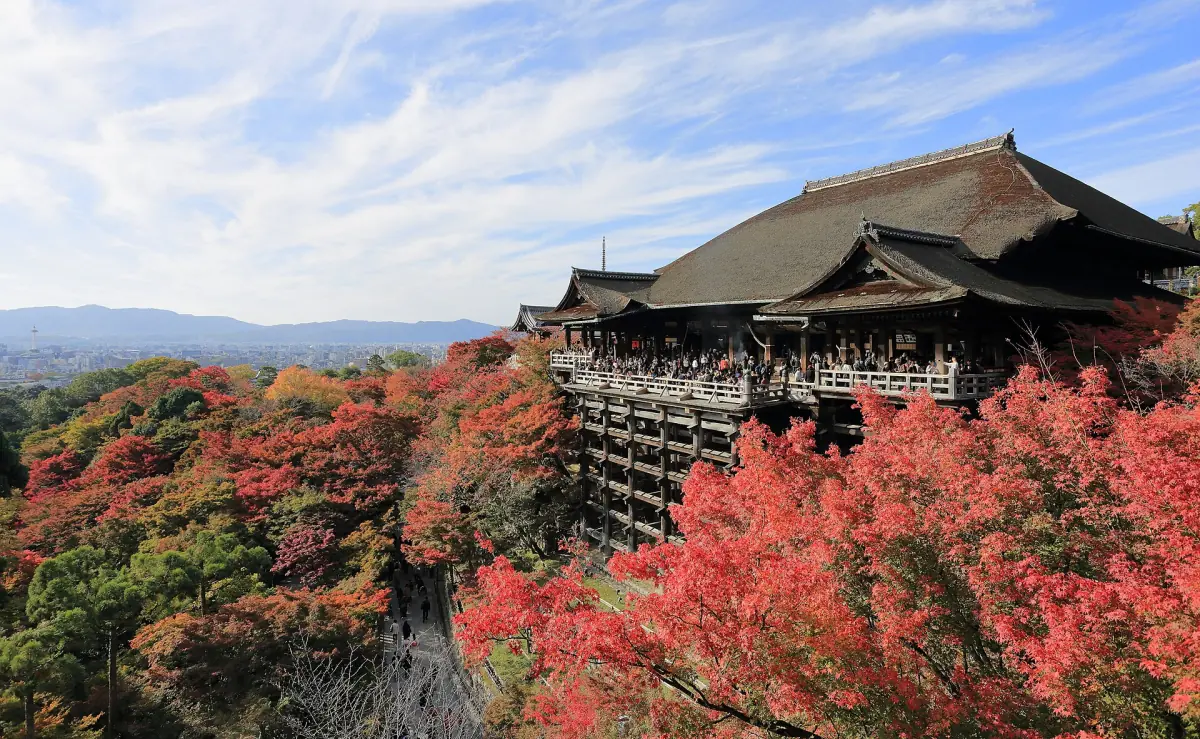
Kiyomizu-dera is a Buddhist temple on the slope of Mount Otowa, in the Higashiyama district of Kyoto. It venerates Kannon, the bodhisattva of compassion. The name means pure water and refers to the Otowa Waterfall below the main hall, which is at the center of the founding tradition.
The temple gives 778 as the year it was founded. The temple was rebuilt several times, and most of the present buildings go back to the 1600s. The main hall and its stage date from 1633. This page puts the main dates in order. For the stage itself see the stage guide.
The founding story
Tradition and dates.
The tradition
The temple tells of a monk named Kenshin who was led by a dream to a spring and met a hermit called Gyoei there. This is the founding tradition of the temple. It is told as a story and not as a documented event.
The date
The temple names 778. Some accounts split the early history into two steps: the opening of the temple in 778 by the monk Enchin, and a later endowment by the general Sakanoue no Tamuramaro, dated to 780 or 798 depending on the account. If you need one date, use 778 and treat the rest as a range.
The name and the water
The Otowa Waterfall gave the temple its name. It is still a stop on the route. Read more on the Otowa Waterfall page.
Kyoto tours with temple history
Guided walks through Higashiyama and the old temple quarter, with live prices and availability. Check whether temple entry is included.
The buildings and their dates
What you can still see and when it was built.
| Building | Date | Notes |
|---|---|---|
| Main hall and stage | 1633 | National Treasure. The stage is about 13 m high and rests on 18 zelkova pillars. |
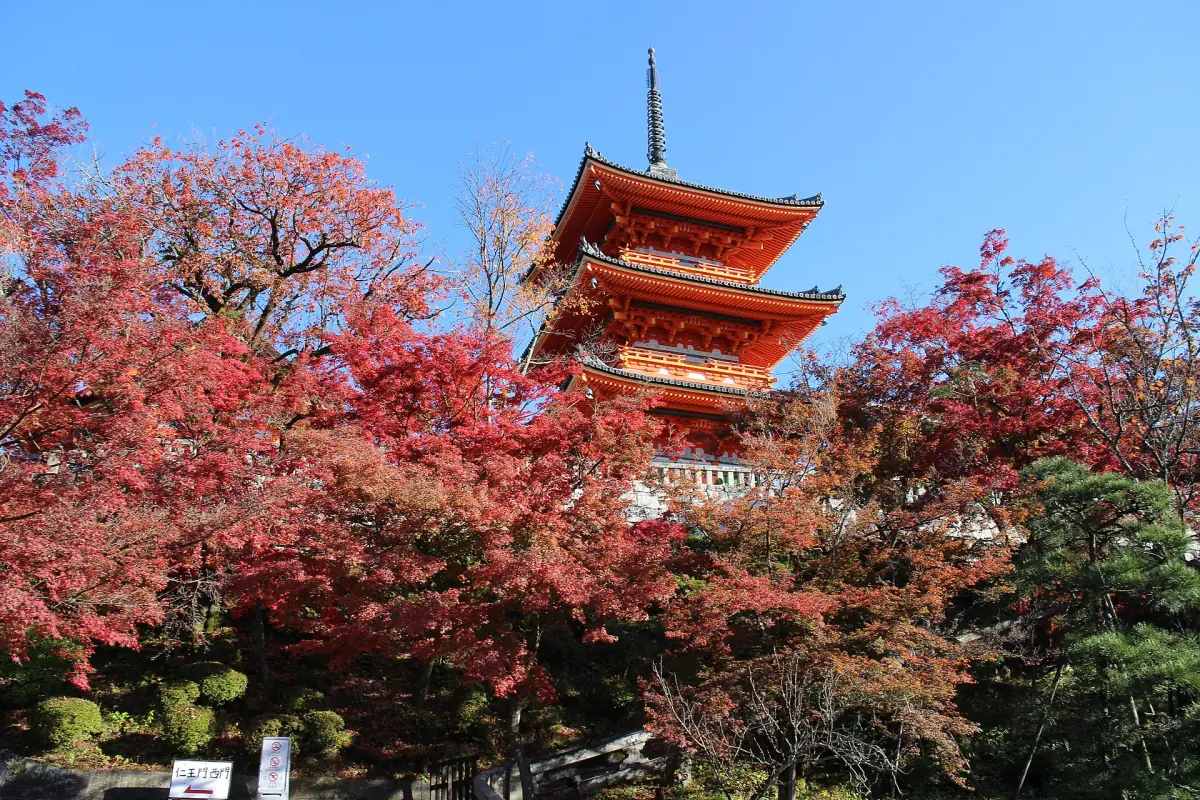
| Three-storey pagoda | 1632 | About 30 m high. The site was founded in 847. Dedicated to Dainichi Nyorai. |
| Niomon (main gate) | Burned 1469, rebuilt around 1500 | Taken apart and restored in 2003. About 10 m wide, 5 m deep and 14 m high. |
| Zuigu-do | 1735 | Houses the dark passage called Tainai-meguri below the hall. |
Do not confuse the temple pagoda with the Yasaka Pagoda, which belongs to Hokan-ji and stands in the old lanes below. See Sannenzaka and Ninenzaka for that one.
The stage and its pillars
A frame of wood without nails in the substructure.
The stage projects from the hall over the slope. Its frame is made of zelkova pillars, some of them from trees more than 400 years old. The largest pillars are about 12 m high with a circumference of about 2 m. Crossbeams run through the pillars and hold the frame together without nails. That description applies to the stage substructure, not to the whole temple.
The present stage dates from 1633, as does the main hall. Most of the buildings on the grounds are rebuilds, not originals.
Restoration from 2017 to 2020
The last large repair of the main hall.
February 2017
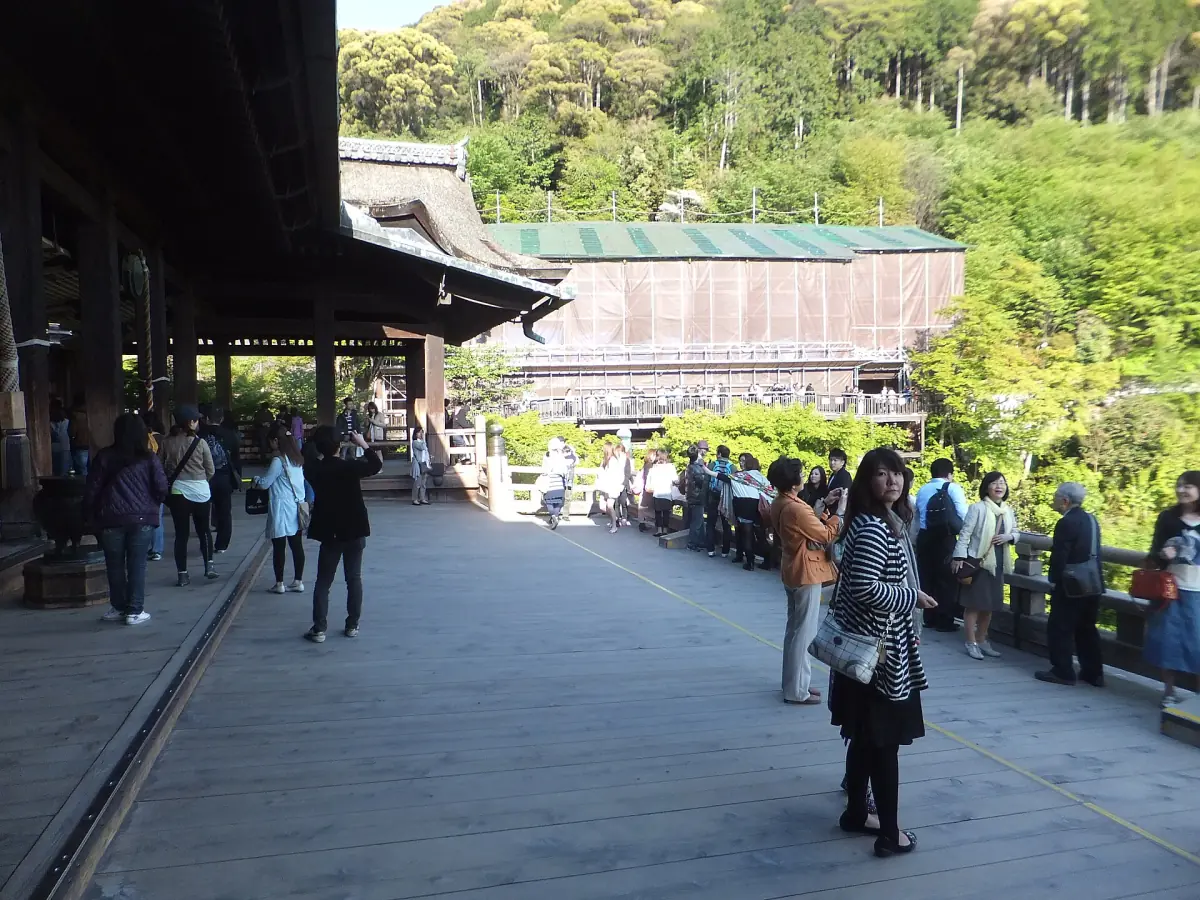
Work on the roof of the main hall began. The hall was covered while the work went on.
End of 2019 and February 2020
The roof was finished at the end of 2019. In February 2020 the covering and scaffold came down.
May to December 2020
The floorboards of the stage were renewed from May 2020. The temple held a ceremony for the end of the repairs on 3 December 2020.
The repairs of the main hall were completed in 2020.
World Heritage status
One of many sites in a larger listing.
Kiyomizu-dera is part of "Historic Monuments of Ancient Kyoto (Kyoto, Uji and Otsu Cities)", which UNESCO inscribed in 1994 under criteria (ii) and (iv). The listing covers many temples, shrines and castles. Kiyomizu-dera is one of them and not the only one.
Another famous Kyoto sanctuary with its own long history is Fushimi Inari. The independent guide covers its history of Fushimi Inari.
To see the temple today, start with the entry and opening hours page. The autumn colors and the evening lighting are covered under night illumination.
Kiyomizu-dera history: frequently asked questions
When was Kiyomizu-dera founded?
The temple names 778. Some accounts date a later endowment by Sakanoue no Tamuramaro to 780 or 798, so early dates vary by account.
Is the main hall the original building?
No. The present main hall and stage date from 1633. The temple was rebuilt several times.
Is Kiyomizu-dera a UNESCO World Heritage site?
Yes, as part of "Historic Monuments of Ancient Kyoto (Kyoto, Uji and Otsu Cities)", inscribed in 1994.
Was the stage built without nails?
The temple describes the crossbeams of the stage substructure as joined through the pillars without nails. That does not apply to every part of the temple.
Is the main hall still under repair?
No. The roof was finished at the end of 2019, the stage floor was renewed from May 2020, and a ceremony marked the end of the repairs on 3 December 2020.